
Choosing Decorative Veneer Plywood in 2026 requires more than matching a sample to a mood board. The right panel must perform under real lighting, changing humidity, repeated cleaning, and daily handling. A warm walnut face may look perfect in a showroom, yet appear darker beside a north-facing window. Small details matter.
Michael Green, a respected architect and wood-construction specialist, has said, “Wood is the only major building material that grows naturally.” His observation supports a careful approach, not automatic environmental claims. Decorative Veneer Plywood still requires responsible forestry, transparent sourcing, durable adhesives, and verified emissions data. Check certifications, technical sheets, and test results. Do not trust a green label alone.
This guide explains how to compare veneer species, grain direction, panel cores, surface grades, and finish options for 2026 projects. It also considers digital veneer matching, repairability, fire performance, and supply consistency. Ask where the timber came from. Ask how the panel was pressed. Ask what happens after installation.
That part is often overlooked.
A practical selection begins with the room’s purpose. Cabinet doors need stable faces and reliable screw holding. Wall panels may prioritize visual continuity and acoustic comfort. High-traffic interiors need tougher finishes than quiet bedrooms. Even experienced designers can choose poorly when samples are too small or lighting is ignored. A little doubt helps. Inspect full-size panels, compare them under several light sources, and request independent documentation before approving the final specification.
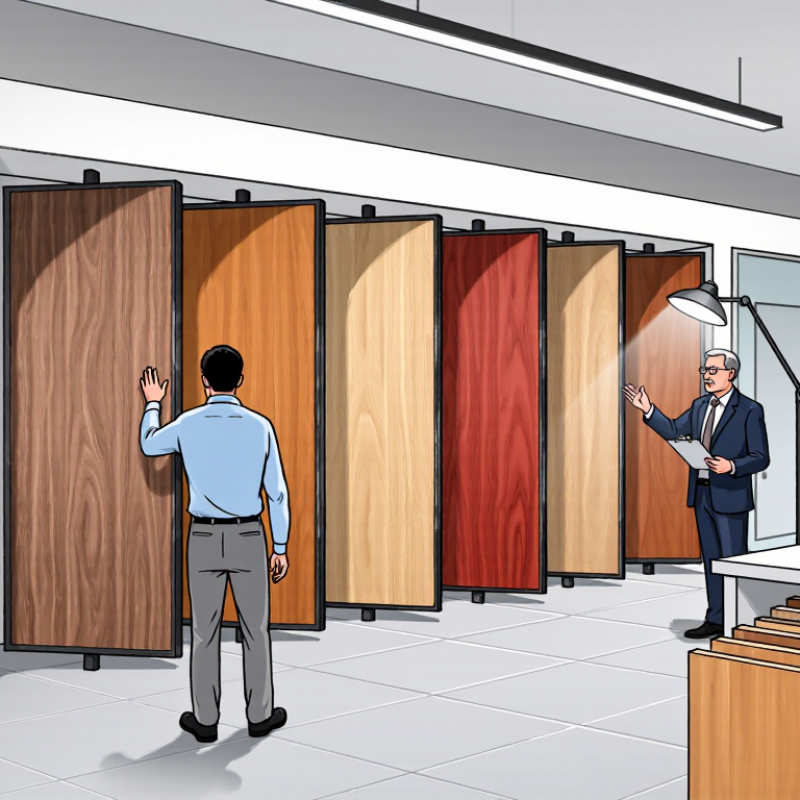
Decorative veneer plywood is an engineered panel with a natural wood surface and a layered plywood core. Thin veneer sheets are sliced from timber, not printed to imitate grain. Their patterns may show straight lines, cathedral shapes, knots, or subtle color changes. The core usually contains several cross-banded layers, which improve strength and reduce warping.
Manufacturing starts with peeling or slicing logs into thin sheets. Workers dry the veneer carefully because uneven moisture can cause cracking later. Adhesive is applied between core layers, then heat and pressure bond them together. A decorative face veneer is added during pressing or in a later stage. The panel is then calibrated, sanded, and sometimes coated with a clear finish. Small surface differences are normal.
When choosing a panel in 2026, inspect the face under natural light. Look for open joints, bubbles, uneven sanding, or mismatched grain. Check the core edges too. Clean layers usually indicate better production control, although appearance alone cannot prove durability. Ask for formal information about thickness tolerance, moisture performance, and adhesive emissions. I have seen attractive panels fail because installers ignored humidity changes. That mistake is easy to repeat. For kitchens, offices, and wall features, select the grade for its actual environment, not only its color. A sample should be tested before a large order. Freshly finished wood can smell strong. That does not automatically mean poor quality, but ventilation and documented compliance still matter.
Decorative veneer plywood is a layered engineered wood panel made by bonding thin wood veneers together, usually with adjacent layers arranged at right angles to improve strength and dimensional stability. The chart shows common nominal panel thicknesses and their typical veneer-ply construction.
Thicker panels generally contain more veneer layers. The values shown are typical construction patterns for commercial decorative veneer plywood; actual ply counts may vary according to veneer thickness, core design, grading standard, and manufacturer specifications.
How to Choose Decorative Veneer Plywood in 2026?
Core material affects strength, stability, weight, and finishing results. Hardwood plywood usually offers better screw holding and fewer edge failures. Poplar, eucalyptus, and birch cores are common choices. MDF cores provide a very smooth surface, but they can swell after water exposure. Particleboard is economical, yet its edges may crumble during cutting. Hold a sample at eye level. Check for gaps, overlapping plies, and uneven glue lines.
Veneer species controls the room’s visual character. Oak shows open grain and strong cathedral patterns. Walnut offers darker color and calmer movement. Ash looks lighter and more linear. Species names alone are not enough. Ask whether the face uses natural veneer, reconstructed veneer, or a printed surface. Natural sheets will show small color changes. That variation is often genuine, not a defect.
Surface grades need careful reading. A-grade faces generally allow fewer knots, patches, and repairs. Lower grades may include filled knots, mineral streaks, or visible joins. The back face can have a different grade. Always inspect both sides and the panel edges. Rub the surface lightly with a clean cloth. Raised fibers may signal weak sanding or moisture movement. I once trusted a beautiful showroom sample and ignored its thin edge banding. The finished cabinet exposed the mistake. Request production-size samples, written grading standards, moisture information, and emissions test records before ordering. Some choices still involve compromise.
A practical comparison of common core constructions, decorative veneer species, and surface-quality grades.
| Category | Option / Grade | How to Identify It | Typical Characteristics | Best-Fit Applications | Selection Checks |
|---|---|---|---|---|---|
| Core Material | Birch plywood core | Look for many thin, evenly stacked plies with small voids and consistent grain direction. | High stiffness, good screw-holding capacity, clean machined edges, and relatively uniform density. | Cabinet doors, furniture, shelving, and visible architectural panels. | Inspect cut edges for gaps, overlapping plies, core splits, and delamination. |
| Core Material | Poplar plywood core | Usually lighter in weight; the edge may show pale, low-density inner plies. | Easy to handle and machine, with lower density and generally lower stiffness than birch plywood. | Lightweight furniture, wall panels, doors, and interior decorative work. | Confirm panel flatness and screw-holding performance where hardware will be installed. |
| Core Material | Eucalyptus or mixed hardwood core | The edge normally contains several hardwood species or varied-color plies; request the construction specification. | Can provide good strength and value, but density, stability, and void content vary by construction. | General furniture, cabinetry, interior partitions, and large decorative panels. | Do not judge quality by species name alone; check ply count, adhesive type, voids, and thickness tolerance. |
| Core Material | Comb core or blockboard-style core | The edge reveals narrow solid-wood strips or blocks between face veneers. | Lightweight and suitable for thick panels; edge stability depends on block quality and bonding. | Interior doors, wide furniture components, and low-weight architectural panels. | Check block alignment, edge gaps, panel flatness, and resistance to screw pull-out. |
| Veneer Species | Oak | Distinct open grain, visible pores, and colors ranging from pale tan to medium brown. | Strong visual grain, good wear perception, and broad compatibility with clear and tinted finishes. | Residential cabinetry, wall cladding, doors, and commercial interiors. | Match crown cut, quarter cut, or rotary cut sheets before ordering multiple panels. |
| Veneer Species | Walnut | Naturally dark brown color with flowing grain and occasional lighter sapwood. | Premium appearance, moderate natural variation, and good depth under a clear finish. | Feature walls, executive furniture, doors, and high-visibility joinery. | Ask whether sapwood is permitted and whether panels are sequence-matched. |
| Veneer Species | Maple | Very light cream to pale golden color with fine, generally subtle grain. | Bright, clean appearance that shows stains and surface defects more readily than darker species. | Minimalist cabinetry, contemporary furniture, and light-colored interiors. | Check for mineral streaks, color variation, pin knots, and consistent finish samples. |
| Veneer Species | Ash | Light background with pronounced, open straight grain and visible growth-ring pattern. | High-contrast grain that remains visible under clear or lightly tinted finishes. | Furniture, slatted walls, doors, and Scandinavian-style interiors. | Review grain direction and tone because adjacent sheets may vary naturally. |
| Veneer Species | Beech | Fine, fairly uniform grain with pale cream to pinkish-brown coloring. | Smooth and relatively uniform visual texture; can darken or warm with finishing. | Furniture, interior panels, fixtures, and curved laminated components. | Use a finished sample because color can change noticeably after coating. |
| Surface Grade | Premium or clear face | Face is selected for consistent color and grain, with very limited open defects; exact limits depend on the supplier specification. | Designed for clear finishing where natural veneer appearance remains fully visible. | Feature panels, high-end cabinetry, doors, and exposed furniture surfaces. | Request written limits for knots, splits, color variation, patches, and veneer joints. |
| Surface Grade | Standard furniture face | May contain small sound knots, minor color variation, filled pinholes, or carefully matched repairs. | Balances appearance and cost; suitable for painted, stained, or clear-coated surfaces. | General cabinetry, shelving, office furniture, and interior wall panels. | View the actual face under normal lighting and confirm acceptable repair visibility. |
| Surface Grade | Utility or paint-grade face | More visible patches, knots, mineral streaks, open grain, and color variation may be present. | Economical option when the panel will be painted, heavily stained, or partly concealed. | Painted components, concealed cabinet parts, backing panels, and shop-built furniture. | Confirm that repairs can be filled or sanded and that the face is suitable for the planned coating. |
| Back Grade | Balanced back | Back veneer is visually acceptable and structurally sound but may not match the face in color or grain. | Reduces the risk of show-through and supports more balanced panel construction. | Freestanding furniture, doors, partitions, and panels visible from both sides. | Specify whether both sides must meet the same visual grade. |
| Surface Finish | Unfinished sanded surface | Surface is sanded for coating but has no factory-applied protective film or decorative topcoat. | Allows custom staining, clear coating, or painting; requires careful site handling. | Custom interiors, joinery, and projects requiring a specific finish system. | Check sanding marks, veneer thickness, surface contamination, and coating compatibility. |
| Surface Finish | Factory-coated surface | Panel is supplied with a cured clear, pigmented, or UV-cured coating; verify coating type in the technical sheet. | More consistent appearance and faster installation, but repairs and color matching may be more difficult. | Ready-to-install wall panels, furniture parts, doors, and commercial fit-outs. | Check gloss level, scratch resistance, edge treatment, repair method, and batch color consistency. |
Choosing decorative veneer plywood in 2026 starts with the room, not a color chart. In a small apartment, pale oak-like grain can reflect daylight and reduce visual weight. In a dim hallway, a warm walnut tone may feel inviting, but it can appear darker than expected. I usually inspect full-size samples beside flooring, paint, and window glass. Small swatches hide knots, grain shifts, and edge color. That mistake is common.
Match the veneer direction to the furniture’s shape. Vertical grain can make tall cabinets feel higher, while horizontal patterns suit long media units. For dining tables and doors, select a durable finish that tolerates repeated contact and careful cleaning. Kitchens and bathrooms need moisture-resistant plywood with sealed edges, not ordinary interior-grade panels. Check the core, face thickness, emission documentation, and installation guidance before ordering. Technical sheets matter more than attractive photographs. They reveal limits.
Design style should follow daily use. A minimalist room benefits from consistent grain, tight joints, and restrained contrast. A hospitality space may need a tougher finish and replaceable panels near entrances. Natural veneer varies, so two sheets will never look perfectly identical. That variation adds character, though clients sometimes read it as a defect. I have learned to approve panels under actual lighting, not only showroom lamps. Recheck the color at morning and evening. Trends change; repair access still matters. Leave room for reconsideration.
Choosing decorative veneer plywood in 2026 starts with thickness, not appearance. I measure the panel against the project’s span, fixing method, and expected load. A 6 mm sheet may suit cabinet backs, while 18 mm plywood feels more stable for doors, shelving, and wall panels. Thin sheets can warp when poorly supported. Check the actual thickness, because sanding and manufacturing tolerance can reduce the stated measurement.
Durability depends on more than a beautiful grain. I inspect the veneer for open joints, bubbling, uneven patches, and damaged edges. Then I examine the core. Several well-bonded layers usually resist splitting better than a weak, uneven core. Press a fingernail into an exposed edge. Excessive softness deserves caution. Hard use needs abrasion-resistant finishing and secure edge sealing. I once selected a visually attractive panel with fragile edges. It looked fine until installation exposed my mistake.
Moisture resistance must match the room. Kitchens, bathrooms, and entrance areas need moisture-rated plywood, sealed edges, and careful ventilation. No panel is waterproof by default. Place a sample near a damp area, if practical, and watch for swelling or lifting after controlled exposure. Safety also matters. Request formal data on adhesive emissions, surface treatments, and fire performance. Look for independent test reports rather than vague claims. Local construction requirements still apply. Some decorative coatings release strong odors at first. Ventilate the room. I would also check the safety sheet, even when the panel appears harmless.
Choosing decorative veneer plywood in 2026 starts with supplier comparison, not showroom color. Ask for recent samples, production dates, core construction, veneer thickness, and moisture readings. A dependable supplier should explain grading, repair limits, panel tolerances, and replacement procedures. I inspect edges under side light. Voids, uneven plies, and open joints often appear there first. Request chain-of-custody documents when responsible sourcing matters. Also check formaldehyde test results and applicable regional standards. A certificate alone cannot prove consistent production. Verify its scope, expiry date, and certificate holder.
Compare delivered prices, not only the quoted panel price. Include packaging, shipping, cutting, waste, taxes, and possible storage fees. Request matching quotations for identical thickness, veneer grade, finish, and panel size. Low prices can hide thinner face veneers or unstable cores. My early estimates sometimes ignored installation waste. That mistake changed the real budget. Ask suppliers for lead times, batch consistency, sample approval, and written claims policies. Factory audits, technical datasheets, and traceable test reports provide stronger evidence than polished sales language.
Installation requirements can decide whether a beautiful panel performs well. Confirm substrate flatness, adhesive compatibility, fire performance, and permitted fixing methods with the installer. Store panels flat in a dry interior space, away from direct sunlight. Allow suitable acclimatization before cutting. Leave movement gaps where the project design requires them. Veneer direction must be planned before installation, especially around doors and joined walls. Some finishes reveal tiny color differences. Approve a full-size mock-up before ordering the complete quantity.
