
Overwhelmed? We're here to help.

What Is Crystal Cat Litter and How Does It Work?

Crystal Cat Litter is made from porous silica gel crystals, not traditional clay. These tiny beads absorb liquid through microscopic openings. Urine spreads across the crystals, while much of its moisture evaporates into the surrounding air. Solid waste remains visible and should be removed daily. The litter usually does not form firm clumps. Instead, the crystals gradually become yellow, damp, or less effective. That change gives owners a useful maintenance signal. A fresh tray feels dry underfoot. An old one may feel heavy and smell sharp.

Dr. Jane Brunt, a veterinarian and cat-care expert, emphasizes a practical principle: “Cats are creatures of habit, and litter box changes should be gradual.” That advice matters when introducing Crystal Cat Litter. Pouring it into a familiar, clean tray can reduce hesitation. Some cats accept the texture immediately. Others dislike the hard, crunchy feeling. Their reaction deserves attention, not dismissal. A gradual mixture may help, although it can make odor control harder during the transition. Keep the tray in a quiet, accessible place, and follow the product’s cleaning instructions. Avoid assuming that stronger odor always means poor litter. It may indicate insufficient depth, infrequent waste removal, or a health concern. Persistent urination changes require veterinary advice. Crystal litter can be convenient, lightweight, and highly absorbent. It is not perfect for every cat. Dust levels, fragrance, tracking, and paw sensitivity still matter. The best choice is the one that keeps the cat comfortable and the box consistently clean. That sounds simple, but daily observation remains essential.
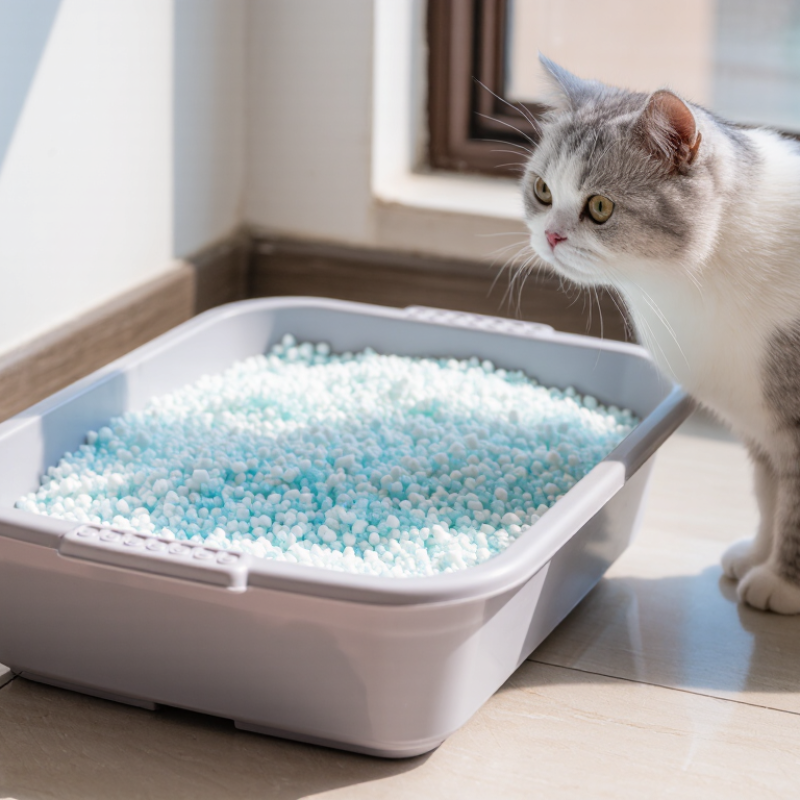
What Is Crystal Cat Litter and How Does It Work?

What Crystal Cat Litter Is: Amorphous Silica Gel and Its Porous Structure

Crystal cat litter is usually made from amorphous silica gel, not traditional mineral crystals. “Amorphous” means its silicon dioxide structure lacks a regular, repeating crystal pattern. Instead, the material forms an irregular network with countless microscopic pores. These pores create a surprisingly large surface area inside each lightweight granule.

That structure matters. When urine contacts the litter, moisture moves across the granule and becomes held within its pores. The process is mainly adsorption, rather than simple absorption like water entering a sponge. Odor molecules can also become trapped, although performance depends on ventilation, box cleanliness, and litter depth.

In daily use, the surface may look dry while the lower layer feels heavier and slightly damp. Removing solid waste regularly helps preserve the available pore space. Stirring the litter can distribute moisture, but excessive stirring may release dust.

I once assumed “crystal” meant a hard, glass-like substance; that description is misleading. The granules are porous, brittle, and intentionally engineered for moisture management.

A practical check is to watch for persistent odor, wet patches, or granules that no longer flow freely. Those signs suggest the pores are nearing saturation. Silica gel can reduce cleaning frequency, but it does not replace routine box washing.

Cats also differ: some dislike the texture or faint sound under their paws. Dust exposure should be minimized, especially around sensitive people or animals. Always follow the product’s handling guidance, and prevent ingestion.

How Sodium Silicate Is Converted into Absorbent Silica Crystals

Crystal cat litter begins with sodium silicate, a mineral-based compound made from silica and an alkali. Manufacturers dissolve it in water, then carefully adjust the solution’s acidity. This change creates silicic acid, which quickly links into a three-dimensional silica network. The wet mass is washed, dried, and broken into granules with tiny internal pores. Those pores do the real work.

When urine touches a granule, liquid moves through the surface and enters its capillaries. The silica gel holds much of the water inside those pores, while the solid granule remains largely intact.

Odor molecules can also become trapped, although performance depends on ventilation, litter depth, and cleaning habits. In everyday use, undisturbed crystals often absorb better than crushed ones. That detail is easy to overlook.

Despite the name, these particles are usually amorphous silica gel, not neat quartz crystals. Their pore structure, not sparkle, controls absorption. Color changes can suggest moisture, but they cannot precisely measure saturation.

Remove solid waste promptly and stir the litter gently to spread dampness. No material performs perfectly. Fine dust may irritate sensitive noses, and saturated granules eventually need replacement. A dry-looking surface can hide liquid below, so checking the tray base remains a practical, imperfect test.

How Micropores Adsorb Moisture: Silica Gel Holds Up to 40% of Its Weight

Crystal cat litter is made from porous, amorphous silica gel. Its key action is adsorption, not simple absorption. Micropores create a vast internal surface, like millions of tiny dry rooms. When urine reaches a crystal, water molecules cling to those surfaces. The liquid stays inside the granule instead of spreading across the tray.

Silica gel can hold up to about 40% of its own weight in moisture under suitable humidity conditions, according to technical adsorption data summarized by the International Union of Pure and Applied Chemistry. That figure is not universal. Particle size, pore structure, temperature, and exposure time all affect performance. A 2024 U.S. Geological Survey minerals report also identifies industrial silica as a major engineered material, supporting its broad technical use. However, the report does not measure cat-litter performance directly. That distinction matters.

In practice, a 100-gram layer may retain roughly 40 grams of water before feeling saturated. Stirring the crystals helps expose unused pores. It does not restore their capacity. Odor control may improve because less free liquid remains, but silica does not chemically remove every odor molecule. I have also found that damp rooms reduce the margin of safety. The “40%” claim needs context, not blind trust. Regular removal of solid waste remains necessary, even when the surface looks dry.

What Is Crystal Cat Litter and How Does It Work? — How Micropores Adsorb Moisture: Silica Gel Holds Up to 40% of Its Weight
Data Dimension Typical Property or Value How It Works in Crystal Litter Practical Meaning
Primary material Amorphous silica gel, a porous form of hydrated silicon dioxide The solid structure contains a large internal surface area and microscopic pores. The litter can hold moisture without dissolving into a liquid.
Moisture capacity Up to approximately 40% of its dry weight under favorable conditions; actual capacity varies with pore structure, humidity, temperature, and formulation. Water molecules attach to the pore walls and accumulate through physical adsorption and capillary effects. A 1 kg quantity may hold up to about 0.4 kg of water in suitable conditions, although household performance may be lower.
Micropore function Pores are typically in the nanometer-scale range, with a broad distribution of pore sizes. Small pores create strong surface interactions and provide many locations for water molecules to adhere. The crystals can capture moisture throughout their interior rather than only on the outside surface.
Adsorption versus absorption The dominant process is adsorption, not simple absorption. Moisture adheres to internal surfaces and occupies pores instead of being taken into a liquid-filled sponge-like body. The crystals usually remain recognizable while becoming heavier and more saturated.
Urine handling Liquid passes between the granules and is then captured by the porous silica. Interparticle spaces allow rapid drainage, while the internal pores retain much of the water. The surface can remain relatively dry when the litter is distributed evenly and stirred regularly.
Solid-waste management Most crystal litters are non-clumping. Silica gel mainly manages liquid moisture; feces generally remain on the surface for removal. Solid waste should be removed promptly because the crystals do not normally form a scoopable urine clump.
Odor control Moisture immobilization can reduce odor development, but it does not eliminate every odor compound. Less free liquid and a drier environment can slow microbial activity and reduce the release of some volatile compounds. Odor performance depends on ventilation, cleaning frequency, litter depth, and the number of cats using the tray.
Saturation signs Common signs include persistent wetness, stronger odor, increased discoloration, or crystals that no longer appear dry after stirring. Available pore space becomes limited as water occupies more adsorption sites. The litter should be replaced according to its condition rather than by a fixed universal schedule.
Recommended maintenance Remove feces daily, stir the crystals to redistribute moisture, and replace saturated material. Redistribution exposes unused pore surfaces and helps prevent wet spots from remaining in one area. Regular maintenance improves moisture distribution and helps extend usable life.
Safety profile Amorphous silica gel is chemically different from respirable crystalline silica, but dust should still be minimized. The material is designed for moisture control, not consumption; loose particles can irritate the eyes or respiratory tract. Pour gently, avoid creating dust, provide ventilation, and prevent pets from ingesting the crystals.
Key limitation Performance is not identical across all crystal sizes, pore structures, tray designs, or household conditions. Adsorption capacity changes with humidity, temperature, contact time, and the amount of silica available. The approximately 40% figure is a maximum reference value, not a guaranteed everyday result.

How Color-Indicator Crystals Reveal Moisture Saturation and Odor Levels

Crystal cat litter uses porous silica gel, a material designed to trap liquid inside tiny cavities. When a cat urinates, the crystals absorb moisture instead of forming a large wet clump. Some formulas include color-indicator crystals that shift shade as liquid accumulates. A pale tray may signal lower moisture saturation, while darker or altered crystals suggest the litter needs attention.

The color does not measure odor directly. It mainly shows moisture and, in some products, chemical changes linked with urine exposure. Odor develops when bacteria break down urine and release ammonia. NIOSH reports ammonia’s odor threshold can range from about 5 to 50 parts per million, depending on conditions and individual sensitivity. Therefore, a strong smell may appear before the crystals look fully saturated. That is an imperfect warning system.

Market data helps explain the demand for clearer monitoring. Grand View Research estimated the global cat litter market at approximately 10.89 billion dollars in 2023, with continued growth expected through 2030. APPA’s 2023–2024 survey recorded about 46.5 million U.S. households with cats. These figures reflect widespread use, not guaranteed product performance. In practice, I check the tray surface, lift the crystals gently, and notice clumping or dampness underneath. Color alone can mislead. Ventilation, tray depth, cleaning frequency, and the cat’s urine output also influence odor. A cat that suddenly produces unusually wet litter may need veterinary attention, even when the indicator color looks normal.

What Is Crystal Cat Litter and How Does It Work?

Silica-crystal litter absorbs liquid into microscopic pores rather than forming clumps. As moisture accumulates, the crystals become increasingly saturated and color-indicator crystals may shift color. Odor-control performance generally declines as available absorption capacity is used, especially when urine remains concentrated in one area. The values shown are non-brand reference ranges based on the typical operating behavior of moisture-absorbing silica crystals.

Safety Standards Explained: OSHA’s 50 μg/m³ Limit for Respirable Crystalline Silica

What Is Crystal Cat Litter and How Does It Work?

Crystal cat litter usually contains porous silica gel crystals. These beads absorb urine and moisture into tiny internal spaces, while solid waste remains visible for removal. When the crystals are clean and intact, they are not the same material as respirable crystalline silica regulated by OSHA. That distinction is important. However, damaged granules can create fine dust during pouring, scooping, or bag emptying. Dust still matters.

OSHA sets a permissible exposure limit of 50 micrograms per cubic meter for respirable crystalline silica, averaged across an eight-hour workday. Its action level is 25 micrograms per cubic meter. These limits apply mainly to workplace exposure, not directly to household cat litter. “Respirable” means particles small enough to travel deep into the lungs. They may be invisible. A dusty litter box can look harmless, yet still deserve attention.

Handle crystals slowly. Avoid shaking the container. Good airflow helps. A wet wipe can collect settled dust better than dry sweeping. Check the floor around the box, especially near corners where powder gathers. If a visible cloud appears, stop and reassess the product or handling method. A simple disposable mask may not provide reliable protection, particularly in a workplace. The label also cannot prove the actual dust level. That is an uncomfortable limitation. For repeated occupational exposure, trained professionals should measure airborne particles and apply OSHA-compliant controls. Keep the litter area away from food, children, and pets, and wash hands after cleaning.

Have questions? We'll help answer all of them. CONTACT SUPPORT
CHAT WITH SALES